Opacity Perception Paper Presented at VISxVISION 2026
Posted Wed Nov 18 2026 by Alark Joshi
Our paper Evaluating Just Noticeable Differences in Layered Opacity Visualizations was presented at the VISxVISION Workshop at IEEE VIS 2026. The work was led by our student Caterina Ponti, together with Shano Liang, Lane Harrison, and Alark Joshi.
Opacity is widely used in data visualization, but people's ability to perceive it is less well understood than channels such as color, length, or size. Building on prior work by Meng et al., which found that some color schemes led to better accuracy when reading opacity, this study asked whether differences in opacity are equally easy to tell apart across the full range of values.
In a within-subjects, two-alternative forced-choice experiment with 96 trials, participants compared 48 opacity pairs under the best- and worst-performing color schemes from Meng et al. Figure 1 gives an overview of the study: on each trial participants picked the more opaque of two side-by-side charts (1), across four base opacity levels, six opacity differences, and the two color schemes (2). A psychometric model then estimated each just-noticeable difference as the opacity change that people detect correctly 75% of the time (3).
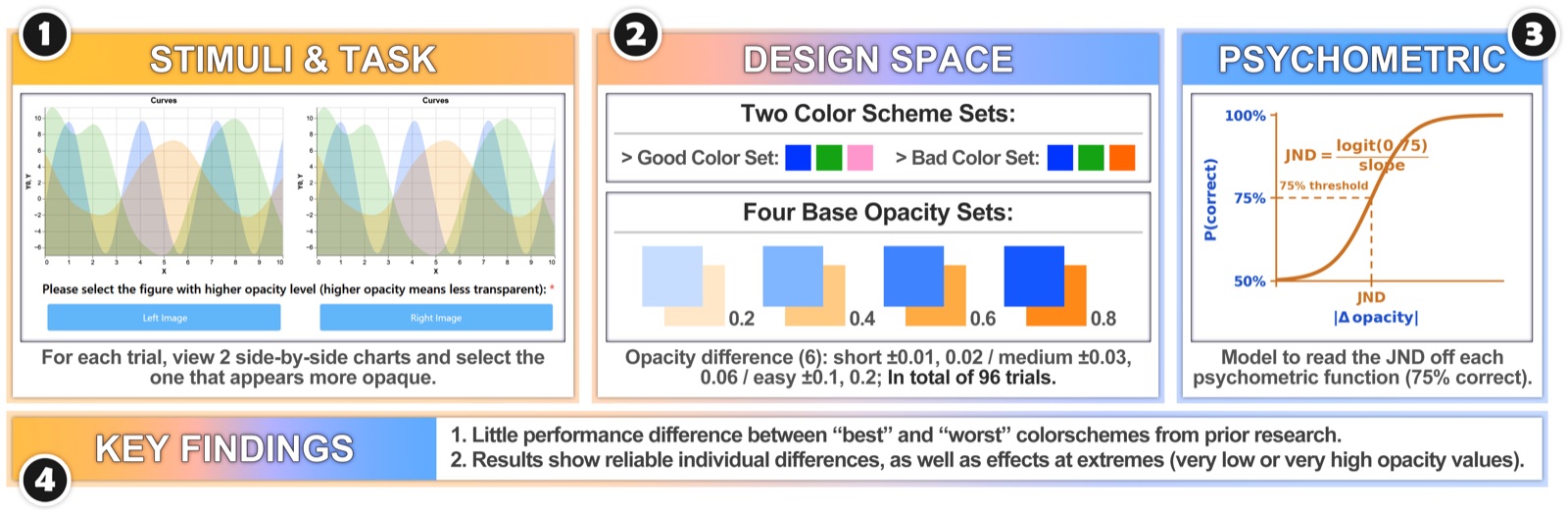
We found:
- Little difference in accuracy between the two color schemes, but larger differences between individual participants.
- Stable performance across the middle of the opacity range.
- More errors when comparing values at the extremes of the opacity range.
The paper discusses what these results mean for visualization design guidelines and future studies. Read the full paper on arXiv (PDF), and see our Research page for more of the lab's work. Congratulations, Caterina!